
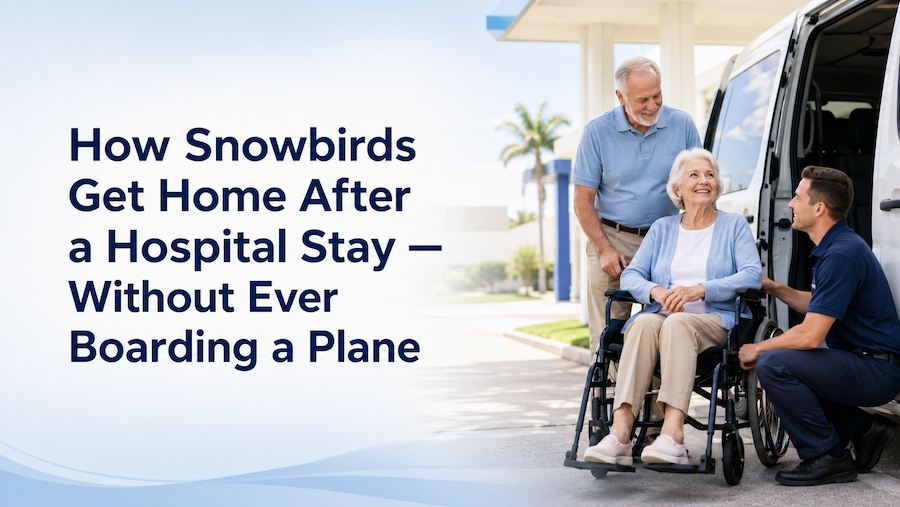
Picture this: you’ve spent a wonderful winter in Arizona or Florida, soaking up the sun, living your best life. Then out of nowhere, a health scare lands you in the hospital. Now you’re hundreds — maybe thousands — of miles from home, your family is worried, and the thought of navigating a commercial airport in your current condition feels impossible. So what do you actually do?
This is the reality for thousands of snowbirds every single year. And the good news? There’s a whole service built specifically for situations like this.
What Is Long Distance Medical Transportation, Exactly?
It’s not an ambulance. It’s not a flight. And it’s definitely not asking your nephew to drive 1,800 miles to come get you. Long distance medical transportation is a specialized non-emergency service that moves patients safely from one location to another — hospital to home, rehab facility to a family member’s house, or anywhere in between — across state lines, across the country, even coast to coast.
Think of it as your personal medical road trip, managed by professionals who know exactly what they’re doing.
Can You Actually Drive Home After a Hospital Discharge?
This is where a lot of snowbirds get stuck. The doctor clears you, but “cleared for discharge” doesn’t mean “ready for a cross-country car ride alone” or “fit to fly.” Many conditions — recent surgery, cardiac events, strokes, hip fractures — require a level of monitoring and positioning that you simply can’t manage in a regular vehicle. And airlines have their own rules about flying post-surgery, often requiring medical clearance or completely restricting travel for weeks.
That’s the gap that long distance medical transportation fills. Professionally.
What the Process Actually Looks Like
Here’s what most clients experience, start to finish:
- You (or a family member) reach out to schedule transport. The friendly staff walks you through everything — no insurance jargon overload, no confusing intake process.
- Medical information is collected and reviewed so the right vehicle and the right level of care is matched to your needs.
- Transport is coordinated with your discharging facility and your destination — whether that’s a hospital back home, a skilled nursing facility, or your own front door.
The vehicles used are modern, fully equipped, and designed for comfort over long distances. Not your average medical van. Real beds, climate control, and trained staff who stay with you the entire way.
Why Snowbirds in Arizona, Florida, and the Southwest Use This Every Season
Phoenix, Scottsdale, Tucson, Naples, Fort Myers — these are the places snowbirds flock to between November and April. They’re also the cities where the question “how do I get home?” becomes a real logistical challenge after a medical event.
Medical transportation for long-distance trips out of these areas is something the team handles on a regular basis. Routes back to the Midwest, the Northeast, the Pacific Northwest — it’s not unusual. It’s Tuesday.
What Makes This Different From Just Hiring a Driver?
Great question. A hired driver doesn’t know what to do if your oxygen levels drop. They can’t assist with transfers, manage medications en route, or communicate with receiving medical staff. The people who staff these transports are trained medical professionals — the kind of people you actually want in the vehicle if something unexpected happens on a long stretch of highway in the middle of nowhere.
Modern equipment matters too. Properly outfitted transport vehicles carry monitoring equipment, stretchers, positioning aids, and whatever else the patient’s specific situation calls for.
Want to Learn More Before You Need It?
Honestly? The best time to learn about long distance medical transportation is before you ever need it. Read more about how to prepare for medical transport as a senior traveler and what families should know when a loved one is hospitalized far from home — both are helpful starting points.
And if you’re already in a situation right now, don’t wait. The team is easy to reach, genuinely helpful, and has handled every kind of scenario you can imagine. There’s no pressure, no obligation — just real answers to real questions.
Getting home after a hospital stay shouldn’t feel like solving a puzzle. With the right medical transportation partner, it doesn’t have to.