
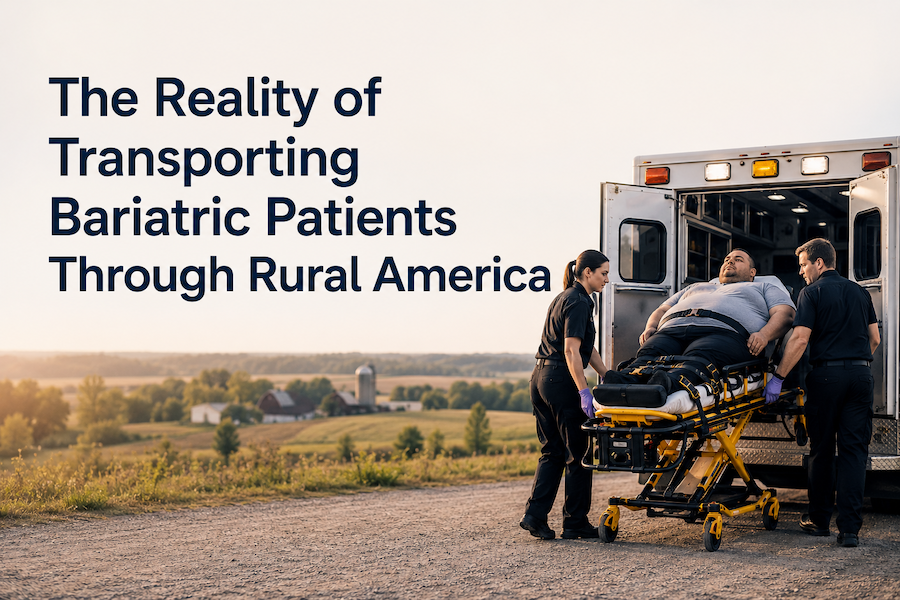
The Reality of Transporting Bariatric Patients Through Rural America
Rural America is beautiful. Wide open roads, small towns, big skies. But when it comes to medical care — especially for bariatric patients who need to travel hundreds of miles for treatment — those same wide open roads can feel like a problem without a solution.
We hear this story constantly. A patient in a rural county needs to get to a specialist facility three states over. The nearest ambulance company doesn’t have the right equipment. The family’s SUV isn’t going to cut it. Air transport is wildly expensive and often not even appropriate for the situation. So what happens?
That’s where specialized long distance medical transportation steps in — and why getting this right matters more than most people realize.
Why Rural Bariatric Transport Is a Category of Its Own
Standard medical transport was not built with bariatric patients in mind. Most stretchers max out around 350 to 450 pounds, vehicle interiors are tight, and a lot of crews simply haven’t trained for the unique challenges of safely loading, securing, and caring for a larger patient across hundreds of miles of road.
Rural areas add another layer. You might be two hours from the nearest city. Road conditions vary. There are fewer options for stops if something goes wrong. The margin for error shrinks considerably when a patient needs consistent care and the next town is forty miles away.
This isn’t a knock on rural communities — it’s just the reality that families face, and it’s one that deserves a real answer.
What “Specialized” Actually Means for Bariatric Transport
Not all medical transportation services are set up the same way. The equipment gap alone can make or break a safe transport. Our fleet is built specifically for patients who need more — more space, more structural support, more attention to how loading and unloading actually works in the real world.
Here’s what proper bariatric-equipped medical transportation looks like in practice:
- Extra-wide hydraulic stretchers that handle higher weight capacities safely, with rear-facing doors that open a full 270 degrees for smooth, dignified loading
- Spacious vehicle cabin design that doesn’t force a larger patient into a position that’s uncomfortable or medically risky over a long haul
Beyond the equipment, it’s about the crew. The people riding with your loved one matter as much as the vehicle. Trained medical staff who understand bariatric care — positioning, pressure point awareness, monitoring vitals over extended hours — make a meaningful difference by mile 300.
Our long distance bariatric transportation services were built around exactly this kind of patient.
So What Does the Trip Actually Look Like?
People often want to know what to expect, especially when they’ve never arranged medical transportation before. Here’s how it typically unfolds.
It starts with a conversation — not paperwork. Our friendly staff walks through the patient’s specific condition, weight, mobility level, any equipment needs like oxygen, and the origin and destination. From there, a custom trip plan gets built around that patient. Not a generic transport package, a plan that accounts for who they are and what they need.
Once the route and crew are confirmed, families receive communication throughout the trip. Long distance means multi-state travel, and that can feel uncertain if you’re waiting at home. Updates matter. So does knowing that the people on board are managing everything — not just driving from A to B, but actively providing care.
For routes that span more than a single driving day, the team handles overnight logistics as well. Patients aren’t just dropped at a hotel and left to manage. The inside look at multi-day medical transport trips breaks down exactly how that works.
The Question Families Ask Most Often
“Will they actually be comfortable?”
It’s a fair question, and it’s one we take seriously. Bariatric patients often have existing skin, joint, or circulatory concerns that get worse with long periods of immobility in the wrong position. Modern solutions — the right stretcher, the right padding, proper repositioning protocols — exist precisely to address this. A long road trip doesn’t have to mean hours of discomfort.
The other question we hear: “What if something happens along the way?” Rural stretches of highway don’t always come with a hospital right off the exit. A properly staffed medical transport vehicle carries trained medical personnel and equipment because that’s what the route demands. That’s not a luxury — it’s the point.
Bariatric Care Doesn’t Stop at the City Limits
The honest truth is that bariatric patients in rural areas are often underserved simply because the right resources haven’t shown up in their area. The nearest specialty facility might be in a major metro two or three states away. That distance doesn’t make the need less real — it just makes the coordination more important.
Why standard stretchers fail for patients over 500 lbs is worth a read if you’re starting to realize that the equipment side of this matters more than you thought. And if your situation involves a patient who’s bed-bound or can’t be repositioned during transport, the approach to bedside to bedside transport covers how that process works from pickup to arrival.
Getting a bariatric patient safely across rural America is absolutely doable. It just has to be done right — with the right vehicle, the right crew, and a team that stays in contact with your family every mile of the way. That’s what this service was built to be.